Keep a set of jumper cables in every vehicle. Sooner or later you or somebody else will need them.
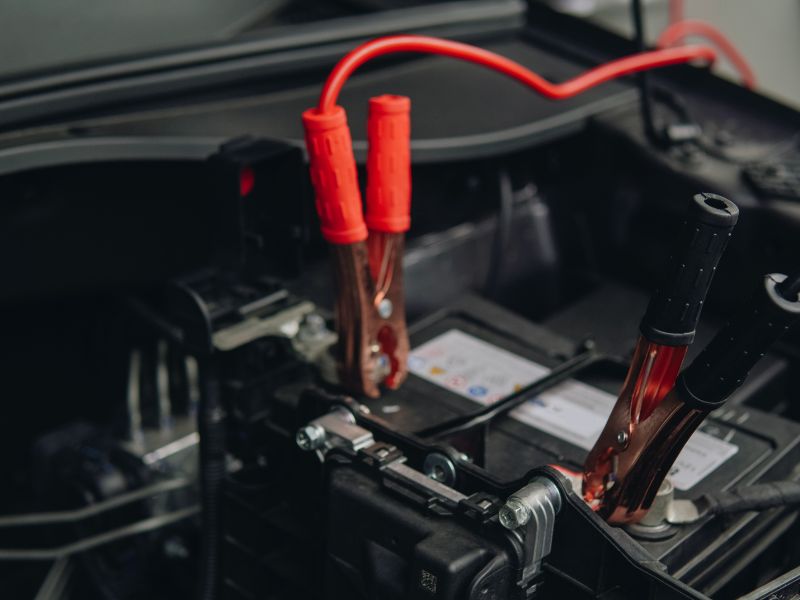
Quick answer Connect in this order: red clamp to the dead battery’s +, red to the good battery’s +, black to the good battery’s −, and the last black clamp to clean unpainted metal on the dead car’s engine, away from the battery. Start the good car, wait a few minutes, start the dead one, then remove the clamps in reverse order.

Tools & materials
- Jumper cables (or a charged jump pack)
- A running vehicle with a similar-voltage battery
- Gloves and eye protection
Steps
- Park the cars close but not touching. Both off, parking brakes on. Check your owner’s manuals; some cars have specific jump points.
- Look at the dead battery. If it’s cracked, leaking or bulging, stop. Don’t jump it.
- Red clamp on the dead battery’s positive (+) terminal.
- Other red clamp on the good battery’s positive (+).
- Black clamp on the good battery’s negative (−).
- Last black clamp on a clean, unpainted metal bolt or bracket on the dead car’s engine, away from the battery and moving parts.
- Start the good car and let it run a few minutes. Then try the dead car.
- Once it runs, remove the clamps in reverse order: black from the engine, black from the good battery, red from the good battery, red from the dead battery.
- Drive a good while or put it on a charger so it can recharge. Then test the battery (see our battery-testing guide).


Safety: Batteries can give off explosive hydrogen gas. That’s why the last connection goes to engine metal and not the dead battery. Don’t let the clamps touch each other while any are connected.