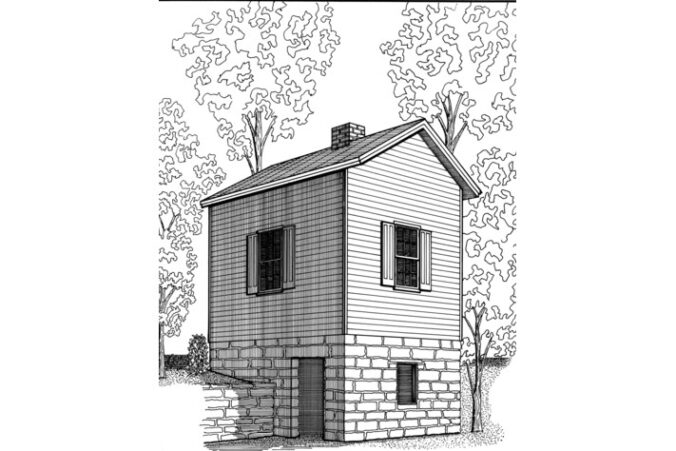
Before there was a refrigerator in every kitchen, a lot of Ozark families had the next best thing: a cold spring coming out of the hillside and a little stone house built right over it.

Why the Ozarks have so many springs
The Ozark Plateau sits mostly on limestone and dolomite. Rain soaks through the leaf litter, picks up a little acid, and slowly dissolves cracks and channels in that rock. Over a very long time that makes caves, sinkholes, losing streams and springs. When the water hits a layer it can’t pass through, it moves sideways until it finds a way out of a hillside or a creek bank. That’s a spring.
The Missouri Department of Conservation puts it simply: spring water is cold, about 56 °F, because that’s the steady temperature of the ground deep below the surface. A 1977 Bittersweet article, written by Lebanon, Missouri, high school students who interviewed Ozark old-timers, puts their springs at “about 58 degrees” year-round. Either way, it’s the key to the whole idea: the water coming out of the hill doesn’t care if it’s July or January.
What a springhouse was (and how it worked)
A springhouse did two jobs at once. It covered the spring so leaves, dirt, livestock and wild animals stayed out of the family’s drinking water, and it used that cold water as a refrigerator.
- Location. Springs usually come out at the base of a hill, so the springhouse was often dug partly into the bank. Sometimes it sat right over the spring; sometimes it sat a little downhill and the water was piped or channeled in.
- The pool and trough. Builders often dug out the spring and lined it with rock, or built a trough in the floor, so cold water ran through a shallow channel and then back outside to the branch or creek.
- Crocks in the water. Milk, cream, butter and cheese went into crocks or jugs set down in the running water. Fruits and vegetables could go in nets or gunny sacks in the water. Meat might hang inside after butchering until it was cooked or smoked.
- Thick stone walls. The earliest Ozark springhouses were often log on sandstone footings, and the logs rotted. Later ones were built with thick rock walls. Stone holds the cool, and a rock building is more likely to survive a flood.
The constant flow also helped in winter. The Bittersweet interviews note that the spring itself hardly ever froze; when ice formed, it was on the water that had already run out into the trough. Break it, and warmer water was still moving underneath. Even the air inside stayed cooler than outdoors in summer and warmer in winter.
It wasn’t all easy. If the spring was downhill from the house, somebody, often the women or kids, made the trip before every meal. One woman interviewed by Bittersweet remembered carrying two buckets up a steep hill: “time you would get up that steep hill with two buckets of water, you’d know you’d been somewhere.” And after a big rain, Ozark springs could run muddy for a day or two and even flood the springhouse until it cleared.
Springhouses weren’t just an Ozark thing. Pennsylvania farms used them for generations, and some had the outlet run to a pond where fish were kept alive until supper. At Hopewell Furnace National Historic Site in Pennsylvania, the National Park Service still shows a springhouse built about 1806–1807, with its water holding at 56 °F.
As iceboxes and then electric refrigerators reached the countryside, the springhouse faded out. A lot of the “well houses” that came later, sheds over a pump and pressure tank, borrowed the same trick: cool groundwater keeps the little building cool.
Dr. John C. Carter’s office over a spring
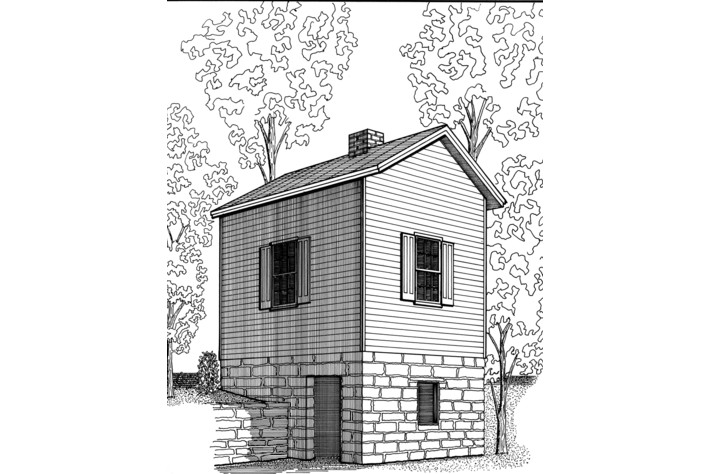
One of the best surviving examples in northwest Arkansas is a little two-story building at the Shiloh Museum of Ozark History in Springdale: Dr. John C. Carter’s office.
According to the Washington County Historical Society, Dr. John Calhoun Carter was probably born around 1828 in Tennessee, came to Washington County in 1851, and, like a lot of men from the area, went to California for the Gold Rush. The Historic American Buildings Survey (HABS) write-up says he went in 1854, came back in 1860, and was apprenticing as a physician. He didn’t enlist in the Civil War; the Historical Society says his neighbors persuaded him he was needed as a doctor at home, and that, like many people in those hills, he was harassed by bushwhackers and is said to have come close to being hanged.
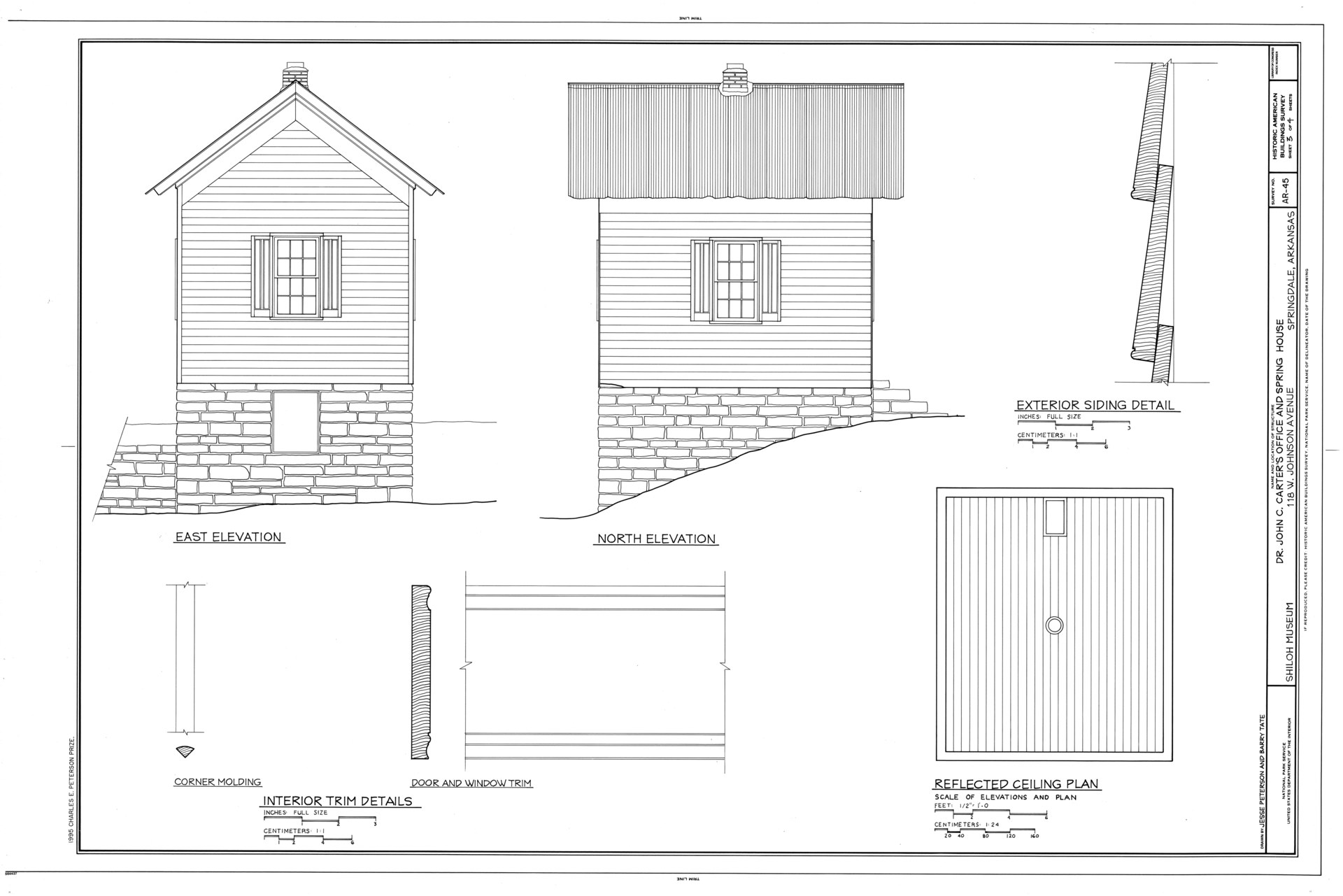
After the war he bought land in the Middle Fork valley of the White River, south of Fayetteville. HABS records that he bought the property in 1871 and probably hired George W. Vanhoose (Van Hoose) to build the office and springhouse, sometime between 1872 and 1883; tax records show big jumps in value in those years. The building is a rural Greek Revival style, set beside the Middle Fork on the road from Sulphur City to Hazel Valley, and its stone foundation enclosed a small spring that drained into the White River. Upstairs was the doctor’s office. Downstairs, the Shiloh Museum notes, the sandstone foundation formed a springhouse for keeping food.
Across the road was Carter’s store, a gathering point for settlers in the valley. A post office named Carter’s Store opened there on July 1, 1875; it was later renamed Carter Store, then Carter, and finally Hicks before it closed in 1953.

The Sulphur City health-resort dream
Carter’s spring wasn’t the only one nearby that people had big plans for. After Eureka Springs boomed as a “healing waters” resort, promoters in the Mankins community nearby renamed it Sulphur Springs, then Sulphur City when they found the first name was already taken. In the early 1880s they put up a springhouse and guest cottages, laid out 24 town blocks, and planned a park and hotel. Promoters claimed the sulphur water helped gout, indigestion, cancer and rheumatism, and the Shiloh Museum says Dr. Carter prepared to give bloodletting and other treatments at his nearby office.
It never took off. Patients would have had to ride ten or more miles from Fayetteville or Elkins over rough roads, and the spring didn’t produce much water. George Van Hoose, writing as the local correspondent for a Fayetteville paper, summed up the hotel: “The timbers of the hotel remain growing in the forest.”
Moved to Springdale
The 1870 census listed Dr. Carter’s occupation as “merchant,” and he ran the store until his death in 1886. HABS found no record of him using the office after 1883. After that it fell out of use; a local woman born in 1911 remembered it being used only for storage, apart from a few weeks in 1935 when she put up out-of-town guests in it as a spare bedroom.
The Shiloh Museum acquired the building in 1986 and moved it to the museum grounds in Springdale in 1987. The office was set back on its original foundation stones, with the springhouse slightly reconfigured to fit the new site. In 1995, University of Arkansas School of Architecture students measured and drew it for HABS, the federal survey whose drawings are kept at the Library of Congress. It’s one of several historic buildings on the museum’s campus at 118 W. Johnson Avenue, and museum admission is free.
Other old-time ways the Ozarks kept things cool
- The spring itself. Before (or instead of) a building, people deepened the spring and lined it with flat sandstone so they could dip a bucket without stirring up mud, and set jugs right in it.
- Caves. Caves hold close to the area’s ground temperature too, and the Bittersweet interviews list “a cave nearby” right alongside springs as a way farmers kept food.
- Wells and cisterns. Lowering a pail of milk or butter down into a well was common where there was no spring.
- Root cellars. Dug into the ground for potatoes, apples, cabbage and other keepers through the winter.
- Smoking, salting and canning. Meat that couldn’t stay cool for long was cured or smoked, and the garden was canned.
Could you use a springhouse today?
Yes, for some things, but not as a replacement for your refrigerator.
Food safety: 55 °F is not 40 °F
The USDA says bacteria grow fastest between 40 °F and 140 °F (the “Danger Zone”), with some doubling in as little as 20 minutes. Refrigerators should be at 40 °F or below. A springhouse running in the mid-50s is a lot cooler than a summer kitchen, but it’s still in that zone. Our grandparents’ milk was used within a day or two and they knew the risk; you don’t have to take it.
What a springhouse, spring-fed cellar or cool stone room is good for:
- Winter squash and pumpkins: about 50–55 °F and fairly dry (University of Missouri Extension). Cure them first, except acorn types.
- Sweet potatoes: about 55–60 °F and humid (Iowa State and UMass Extension). Below 50–55 °F they get chilling injury.
- Potatoes: they like it colder, about 38–45 °F. In a 55 °F room expect them to sprout in a couple of months.
- Canned goods, drinks, a watermelon on a hot day, and keeping anything out of the heat. And a cool spot to work in July.
Don’t store apples or other ripening fruit next to potatoes or squash; ripening fruit gives off ethylene gas that makes potatoes sprout and shortens squash storage. Keep an appliance thermometer in there so you know what it’s really doing through the year.
Drinking water: test it
Clear, cold spring water looks pure, but springs are fed by shallow groundwater, and in karst country like the Ozarks water can travel fast through the rock with little filtering. The Missouri Department of Conservation says to treat spring water like any other creek water. Penn State Extension recommends:
- Test before you use a spring for drinking, at a state-certified lab, and test for coliform bacteria at least once a year after that.
- Build or repair a watertight spring box with a tight-fitting lid, an outlet pipe, an overflow and a drain, so insects, animals and surface water can’t get in.
- Divert surface runoff away, fence livestock out of the spring’s drainage area, and keep other activities at least 100 feet from the box.
- Expect to need treatment. Most springs need some, and if bacteria keep showing up, plan on continuous disinfection such as UV.
In Arkansas, your county health unit or the Arkansas Department of Health can point you to water testing. Also check the water after big rains, when Ozark springs are most likely to run cloudy.
If you want to see one
The Shiloh Museum of Ozark History at 118 W. Johnson Avenue in Springdale has Dr. Carter’s office on its grounds along with a log cabin, a general store, a barn and other buildings moved in from around the region. The museum is open Monday through Saturday, 10 a.m. to 5 p.m., with free admission (check its Plan Your Visit page before you go). Down in the Middle Fork valley, the Shiloh Museum says a tumbled stone wall and the sulphur smell still mark the old Sulphur City spring along County Road 57, across from the Sulphur City Baptist Church.
Related on djgaston.com
- Arkansas and Ozarks History Worth Knowing
- Our Former Hideaway (the old zinc mines on our former Ozark property)
- Venomous Snakes of Arkansas
- How to Winterize Outdoor Faucets
- Backyard Chickens Basics
- All how-to guides
Follow Danny on X: @djgaston
Sources
- Library of Congress, Historic American Buildings Survey, “Dr. John C. Carter’s Office & Springhouse, 118 West Johnson Avenue, Springdale, Washington County, AR” (HABS AR-45): loc.gov/item/ar0122
- Shiloh Museum of Ozark History, “Plan Your Visit”: shilohmuseum.org/plan-your-visit
- Shiloh Museum of Ozark History, “Campus” and “Collections”: shilohmuseum.org/campus; collections
- Shiloh Museum of Ozark History, “Healing Waters” (Sulphur City): shilohmuseum.org/project/healing-waters
- Washington County Historical Society, “Carter’s Store”: washcohistoricalsociety.org/Carters_Store
- Bittersweet (Lebanon, Mo., Summer 1977), springs and springhouses, via Springfield-Greene County Library: sgcld.thelibrary.org
- Missouri Department of Conservation, “Springs”: mdc.mo.gov
- The Goschenhoppen Historians, “Spring Houses”: goschenhoppen.org/spring-houses
- National Park Service, Hopewell Furnace NHS, “Spring House”: nps.gov/hofu/spring-house.htm
- State of the Ozarks, “Ozark Spring Houses”: stateoftheozarks.net
- USDA FSIS, “‘Danger Zone’ (40°F – 140°F)” and “Refrigeration & Food Safety”: fsis.usda.gov
- University of Missouri Extension, “Home Storage of Fruits and Vegetables in Root Cellars” (MP562): extension.missouri.edu
- Iowa State University Extension, “Storing Winter Storage Vegetables”: extension.iastate.edu
- UMass Amherst, “Optimal Storage Conditions and Ethylene Sensitivity of Fall Storage Crops”: umass.edu
- Penn State Extension, “Spring Development and Protection,” “Private Water Systems” and “Shock Chlorination of Wells and Springs”: extension.psu.edu