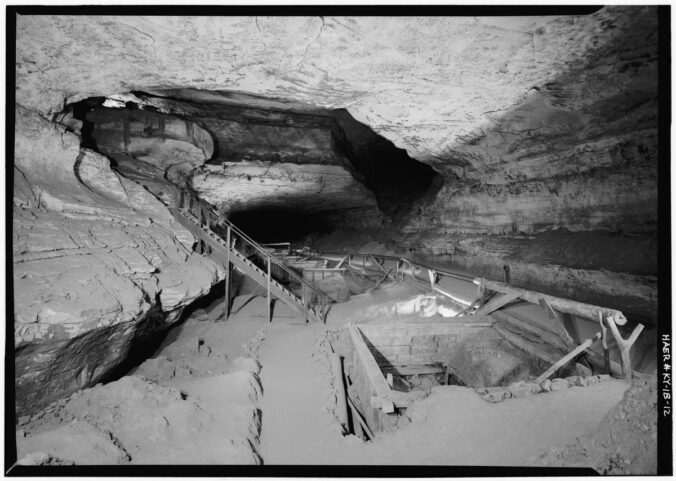
Long before anybody sold tickets to Ozark caves, men were in them with shovels and mattocks, hauling out the dirt. That dirt held saltpeter, the main ingredient in black powder. During the Civil War, a little bluff cave on the White River in Marion County, Arkansas, called Bean Cave, was worth sending cavalry to wreck.
What saltpeter is and why it mattered
Black powder is saltpeter, charcoal and sulfur. In a 1967 history of Bean Cave, Lee Carson Davis noted that saltpeter (also called potash nitrate or potassium nitrate) made up 75% of the mix by weight. On the frontier, and later in a Confederacy cut off from Northern suppliers, powder had to be made locally.
The National Park Service explains that thousands of years of bat guano made cave dirt rich in calcium nitrate. That isn’t saltpeter yet. It has to be combined with something high in potassium, and on the frontier that meant wood ashes. A Missouri Civil War marker at Meramec Caverns adds that nitrates keep best in caves around 60 °F with low humidity and dry earth floors.
How cave dirt became saltpeter
In 1861 Maj. George W. Rains, in charge of the Confederate gunpowder department, printed Notes on Making Saltpetre from the Earth of the Caves so people near caves could do it themselves. His pamphlet, Owen’s 1858 Arkansas report and the Park Service’s Mammoth Cave material describe the same basic steps:
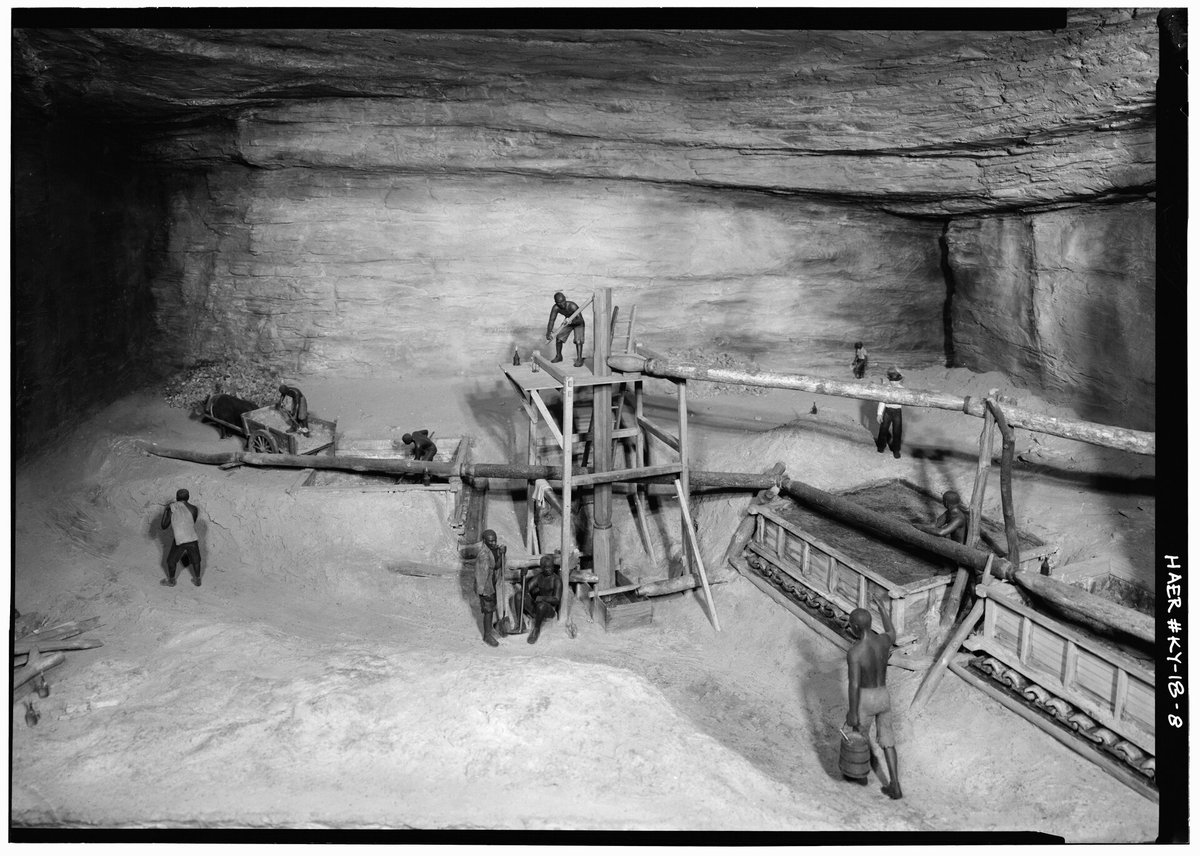
- Dig and haul. Workers broke up the cave earth and carried it out in bags or wheelbarrows. Rains said it was cheaper to set up the vats inside the cave, beside the dirt, when there was room.
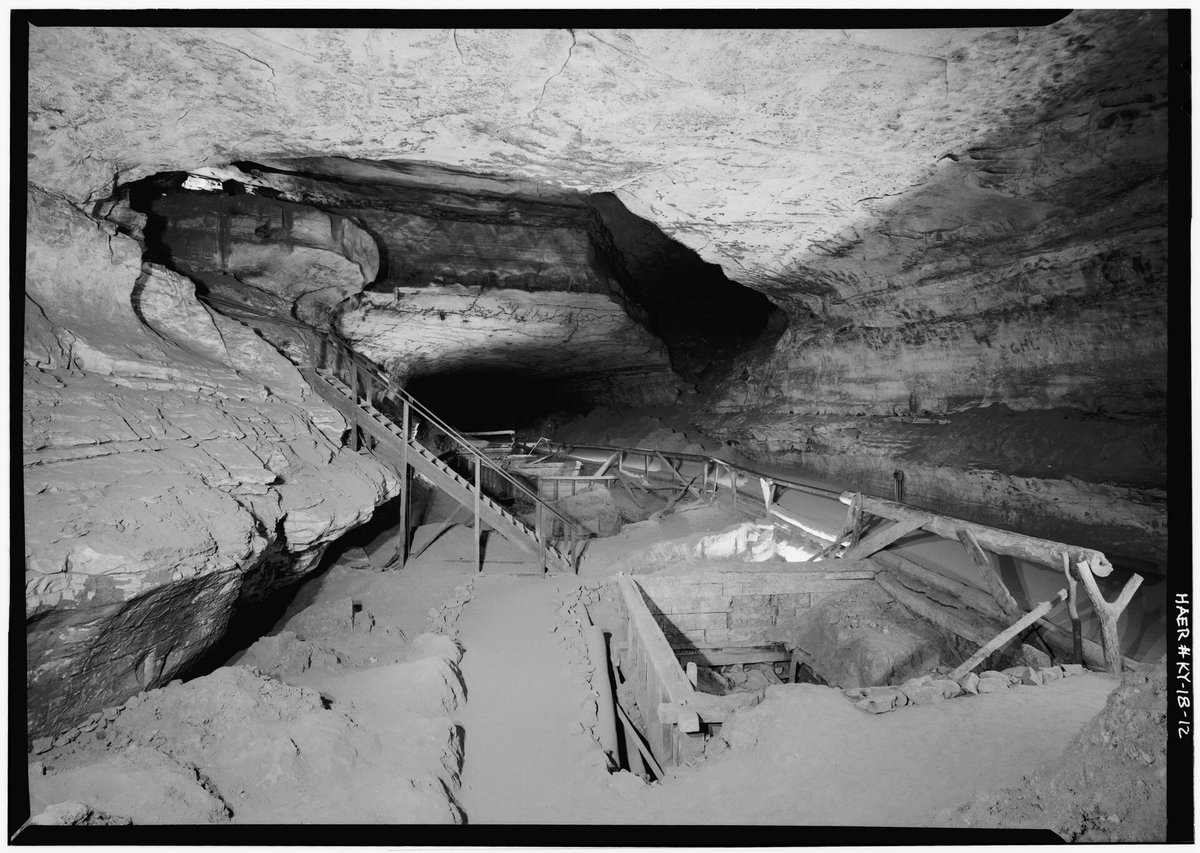
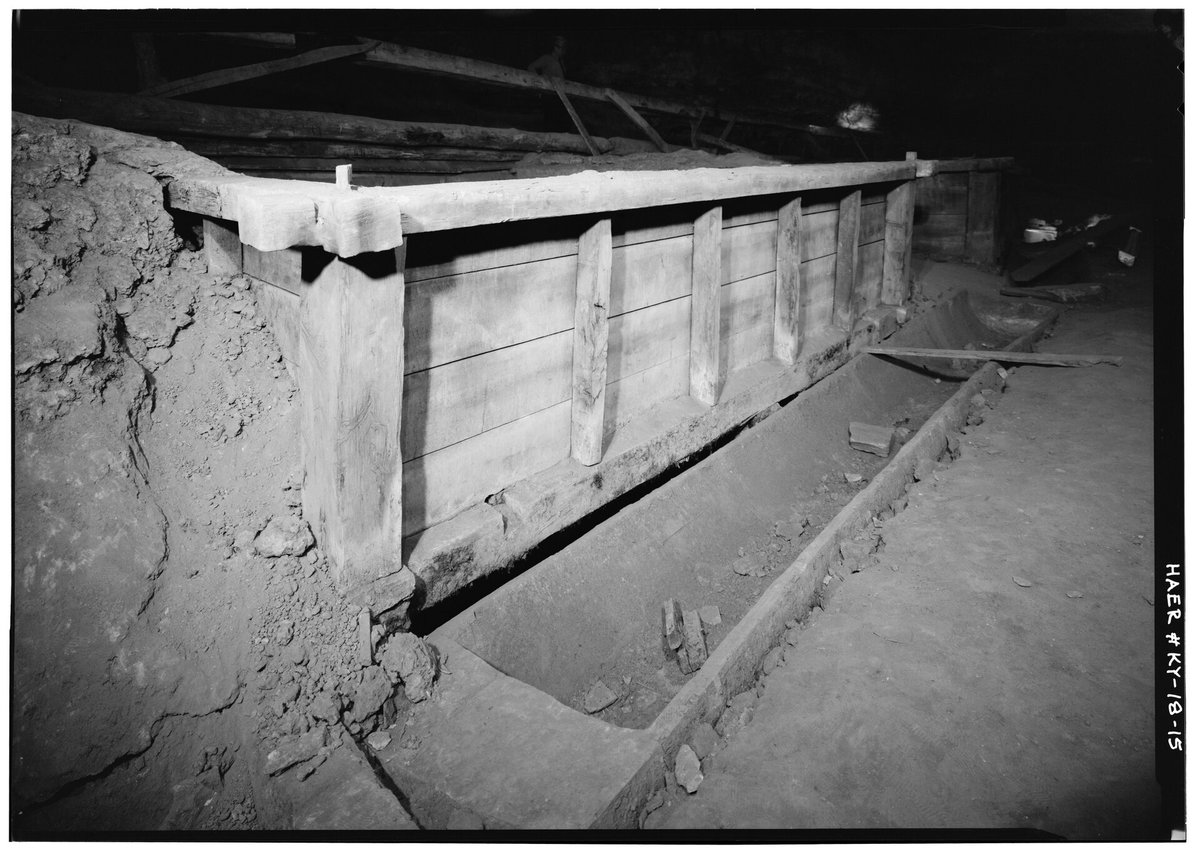
- Load the hoppers. Small outfits used barrels with a plugged hole near the bottom, lined with twigs and straw. Larger works built V-shaped vats by setting the lower ends of planks about four feet long into a trough and spreading the tops about three feet apart. Mammoth Cave used big square wooden vats.
- Leach it. Water soaked down through the dirt, and the liquid that drained out, called the “liquor” or “beer,” carried the nitrates. Rains said to run it through a second and third batch of fresh dirt before boiling. Boiling weak liquor wasted fuel, which he called “a common error at the caves.”
- Add lye. Lye was leached from wood ashes the same way. Rains wrote that oak and ash, plus the leaves, bark and limbs, gave the most potash. Stirred into the liquor, the lye made it cloud and “curdle” as impurities dropped out. Workers kept adding lye until the clouding stopped.
- Boil and crystallize. The cleared liquor was boiled in an iron kettle until a drop hardened on cold metal. Then it was strained into a tub, and saltpeter crystals formed as it cooled. The leftover “mother liquor” went back in the kettle.
- Dry and ship. The crystals were dried and sacked. This crude cave saltpeter still had to be refined before it went to the powder mills.
Rains even gave a field test: dip paper in boiled-down liquor and dry it. If it “burns rapidly and sparkles” when touched with a coal, the dirt has saltpeter in it. Miners also believed spent dirt would recharge. An 1811 traveler, quoted in the Journal of Spelean History, was told that earth spread back on a cave floor was “re-impregnated in the space of four or five years.”
Arkansas saltpeter and the Confederacy
The Encyclopedia of Arkansas says early settlers already knew about saltpeter in Madison, Searcy, Independence, Marion and Newton counties. State geologist David Dale Owen’s survey, whose first report covered 1857 and 1858, described several “nitre caves” and analyzed their dirt.
The war made those caves valuable. Davis writes that in August 1861 Gen. Leonidas Polk told Jefferson Davis that two New Orleans chemists had found “any amount” of saltpeter in the White River caves. But the mines were badly worked, and the government was paying 25 cents a pound for saltpeter it could make itself for 10 cents. Polk urged the government to take the caves over and run them.
The Confederate Nitre and Mining Bureau ended up protecting the works, and its workers were exempt from military service. The encyclopedia says the problems were labor, security and transportation. After Pea Ridge in March 1862, Union troops could reach the Ozarks easily, many locals were Unionists, and saltpeter had to be hauled overland to the White River. The Bureau’s habit was to pull back when Federals came near and return a few weeks later. In July 1862 its superintendent, I. M. St. John, reported 17,000 pounds made in Arkansas before May 1 that couldn’t be counted “until the events of the war permit.”
By September 1863 the Bureau had left Arkansas. A January 1864 Confederate ordnance report in the Official Records says the north Arkansas niter caves “have all been abandoned from the approach of the enemy,” and that Maj. Isaac Read had gone to work caves in Texas. Guerrillas kept mining until the war ended, but the encyclopedia calls the Arkansas effort an ultimate failure.
Bean Cave, Marion County
Owen’s assistant, Edward T. Cox, described a bluff about 250 feet high on the immediate bank of the White River, in what was called the Horseshoe Bend, with “a number of rock-house caves” in it. The main one was “known generally as the Bean cave.” It was about 30 feet wide at the mouth, ran back a hundred feet or more, and averaged about eight feet high. Its walls were laminated, iron-red clay that crumbled to powder after it was dug down and left to dry. The dirt yielded about 3 to 6% saltpeter, and Owen noted that France’s artificial nitre beds averaged about 4%.
Cox found signs of much older work: “an old decayed leaching-hopper.” Early settlers told him a man named Bean once made nitre there, killed his partner in a quarrel and quit, “and to this day, the cave is known under the name of the ‘Bean cave.'” A second, wider cave sat about 100 yards away in the same bluff. Smith & Co. of Elgin had bought the land to make saltpeter, and an 1861 Nashville newspaper noted that small steamboats could reach the cave for much of the year.
Then came the raids:
- April 19, 1862. Men under Capt. James T. Drummond of the 4th Iowa Cavalry crossed the White River in canoes, damaged a Confederate saltpeter works and burned buildings nearby. A Union howitzer broke up return fire from about 50 Confederates near Talbot’s (Talbert’s) Ferry, and Lt. William A. Heacock was mortally wounded. Davis identifies the works as Bean’s Cave.
- Late November 1862. Col. Dudley Wickersham’s cavalry raid on Yellville disrupted the Bean Cave works, but according to the Encyclopedia of Arkansas they were soon running again.
- December 1862. Capt. Milton Burch of the 14th Missouri State Militia Cavalry came through the woods with a local guide, Willoughby Hall, and reached the cave at noon while the Confederates were eating. “They mistook us for a company of their own men,” Burch reported, and they gave up without a shot. His men smashed an engine, six tanks and 26 large kettles with sledgehammers, burned five buildings, and destroyed $6,000 worth of saltpeter and 500 barrels of jerked beef.
- April 1863. Davis says Union cavalry visited the works once more, and after that the cave “never achieved any importance.”
Some details are disputed. A local account by Thomas J. Estes, quoted by Davis, says men were killed in the December raid, which conflicts with Burch’s report. There’s also a legend about a buried keg of money, which is just folklore.
What I couldn’t verify: who owns Bean Cave today, whether anyone can visit it, and how the area has changed since Bull Shoals Lake was built. Davis’s 1967 article is the most recent detailed description I found, so treat anything newer you read online with caution.
Other documented Ozark niter caves
- Cave Creek, Newton County. Owen describes several nitre caves here. One 200-bushel hopper from the main cave produced 1,000 pounds of saltpeter “in a very rude manner.” The same cave held bones, an ivory dirk and an infant’s skeleton in a willow basket, so it was an archeological site long before it was a mine.
- Buffalo River. In January 1863 the 1st Iowa Cavalry surprised a works 14 miles from Kingston and destroyed 14 buildings, two steam engines and seven 800-pound kettles. A second works four miles downstream was destroyed too. The Park Service tells this story on its Bat Cave page, and the Encyclopedia of Arkansas says Boxley became a target because of nitre mined from bat guano on Cave Mountain.
- Missouri Ozarks. The Journal of Spelean History says Henry Rowe Schoolcraft found saltpeter caves being worked on the Meramec and Gasconade in 1818. William H. Ashley ran a saltpeter plant at Ashley’s Cave in Texas County and supplied his powder factory at Potosi. Saltpeter Cave on the Meramec, now Meramec Caverns, was used by Southern sympathizers early in the Civil War, according to its marker.
What traces remain
In 1967 Davis wrote that at Bean Cave “only the excavations in the clay floor and walls” still showed what it had been used for. Two broken kettles were on display at a commercial cave in eastern Marion County, and a third had been used to scald hogs on a Baxter County farm. Don’t assume they’re still in those places.
Better-studied caves show what else to look for. A National Register nomination for a Kentucky saltpeter cave lists spoil piles of leached dirt stacked to the ceiling, dried-dirt “casts” of vats that still show board impressions, pick marks in dirt faces, and floors dug down several feet. It also notes that visitors did the most damage, taking vat boards as souvenirs or firewood.
Mining didn’t erase the older history underneath. The Arkansas Archeological Survey excavated a Saltpeter Cave in Newton County in 1969 and 1970. Even though it had been mined during the Civil War, the Survey found nearly 14 feet of deposits covering at least 9,000 years. The site had also been looted, including a burial removed in the early 1960s.
Visiting today: closures, bats, permission, safety
Many caves are closed. Every cave and mine in the Ozark-St. Francis National Forest except Blanchard Springs Caverns is closed by order of the regional forester because of white-nose syndrome. At Buffalo National River, all caves are closed to recreational caving except Eden Falls Cave and Natural Bridge in Lost Valley and Panther Cave and Indian Rockhouse at Buffalo Point. Back O’Beyond and Silver Hill caves are open for guided tours only. In Missouri, caves on Conservation Department land have been closed to the public since 2010, apart from guided programs.
White-nose syndrome is here. Arkansas first confirmed it in 2012, in northern long-eared bats from a Marion County cave. By 2019 it had reached 15 counties, and tricolored bats dropped about 66% from 2015 to 2017. Spores ride on clothes, boots and gear, so decontaminate everything before and after a cave trip following the national protocol, and stay away from hibernating bats.
Get permission. The Arkansas Game and Fish Commission has encouraged landowners to keep the public out of their caves. Both the Encyclopedia of Arkansas and the Missouri Department of Conservation say to check with the landowner or manager first. If you’re not sure whose land it is, see How to Find Your Property Lines.
Basic safety, from the U.S. Forest Service: never cave alone (go with four to eight people), and tell someone who isn’t going when you’ll be back. Wear a helmet with a light, boots and gloves, and carry three light sources per person. Stay out when rain is forecast, since caves can flood suddenly, and don’t drink cave water.
The law: look, photograph, leave it
Arkansas. Under the Arkansas Cave Resources Protection Act (Act 523 of 1989, Ark. Code § 15-20-603), it’s a Class A misdemeanor to do any of these on purpose or recklessly without the owner’s express permission:
- Deface cave surfaces or formations.
- Remove protected material.
- Damage a cave gate.
- “Excavate, deface, or disrupt the integrity of any identifiable archeological or paleontological site” in a cave.
The act counts anything 50 years old or older as an archaeological site, which covers Civil War vats and kettles. Walking into an unposted cave isn’t a violation by itself.
Federal land. On national park and national forest land, the Archaeological Resources Protection Act (ARPA) covers remains of human activity at least 100 years old, including tools and structures. The Park Service says excavating or trafficking can mean up to two years in prison and a $20,000 fine, and that ARPA cases have been prosecuted at Buffalo National River.
If you find an old kettle, vat board or tool, take a picture, leave it where it is, and tell the landowner or land manager.
If you want to see one
The Park Service’s Rotunda stop at Mammoth Cave National Park in Kentucky shows original vats and the remains of a pump tower just inside the Historic Entrance. Meramec Caverns near Stanton, Missouri, has recreated V-shaped hoppers inside the cave and a Civil War marker at the entrance. For more Ozark history, see Ozark Springhouses and Arkansas and Ozarks History Worth Knowing.
Related on djgaston.com
- Arkansas and Ozarks History Worth Knowing
- Ozark Springhouses: How Families Kept Food Cold Before Refrigerators
- Venomous Snakes of Arkansas and the Ozarks
- How to Start (and Put Out) a Campfire Safely
- How to Find Your Property Lines
- All how-to guides
Sources
- Lee Carson Davis, “Bean Cave, Marion County, Arkansas,” White River Valley Historical Quarterly 2 (Spring 1967), via Springfield-Greene County Library: sgcld.thelibrary.org
- David Dale Owen, First Report of a Geological Reconnoissance of the Northern Counties of Arkansas, Made During the Years 1857 and 1858 (1858), including E. T. Cox’s Marion County report: archive.org
- George W. Rains, Notes on Making Saltpetre from the Earth of the Caves (New Orleans, 1861): archive.org
- Encyclopedia of Arkansas, “Saltpeter Mining”: encyclopediaofarkansas.net
- Encyclopedia of Arkansas, “Expedition from Ozark, Missouri, to Marion County (December 9–15, 1862)”: encyclopediaofarkansas.net
- Encyclopedia of Arkansas, “Yellville Expedition (November 25–29, 1862)”: encyclopediaofarkansas.net
- Encyclopedia of Arkansas, “Skirmish at Talbot’s Ferry”: encyclopediaofarkansas.net
- Encyclopedia of Arkansas, “Boxley (Newton County)” and “White Nose Syndrome”: Boxley; White Nose Syndrome
- National Park Service, Buffalo National River, “Union Raid on Saltpeter Works at Bat Cave” and “Cave / Karst Systems”: nps.gov/buff; cave closures
- Official Records, Series I, Vol. 22, Part 2 (Huger report, Trans-Mississippi Ordnance, January 1864), transcription: civilwar.com
- Nashville Union and American, August 17, 1861 (“Gunpowder for the South”), Chronicling America, transcribed at Ozarks’ History: ozarkshistory.blogspot.com
- National Park Service, Mammoth Cave, “From Dirt to Gunpowder” and “Saltpetre Vats (Rotunda)”: nps.gov; Rotunda
- Library of Congress, HAER KY-18, “Mammoth Cave Saltpeter Works”: loc.gov/item/ky0272
- Dwight Weaver, “Early Gunpowder Making and Saltpetre Mining in Missouri Caves,” Journal of Spelean History, hosted by the National Speleological Society: caves.org
- Historical Marker Database, “Saltpeter Cave” (Missouri’s Civil War Heritage Foundation marker, Meramec Caverns): hmdb.org
- National Register of Historic Places nomination, Saltpeter Cave (15Cr99), Carter County, Ky.: npgallery.nps.gov
- Arkansas Archeological Survey, “Saltpeter Cave” and “Dating Saltpeter Cave”: archeology.uark.edu
- U.S. Forest Service, Ozark-St. Francis NF “Climbing and Caving” and “Cave Safety”: fs.usda.gov; cave safety
- Missouri Department of Conservation, “Missouri Caves” (Missouri Conservationist, March 2023): mdc.mo.gov
- Arkansas Cave Resources Protection Act, Act 523 of 1989 (Arkansas Archeological Survey copy) and Ark. Code § 15-20-603: Act 523; § 15-20-603
- National Park Service, “Archaeological Resources Protection Act of 1979,” and 16 U.S.C. § 470bb: nps.gov; law.cornell.edu
Follow Danny on X: @djgaston19